Dubai investment properties are no longer a niche play for high net worth Australians. Every day, investors are running the numbers, and the comparison with home markets is hard to ignore.
Sydney gross rental yields sit at just 3.1% as of March 2026, according to Cotality. Melbourne comes in at 3.5%. Meanwhile, established Dubai communities are averaging 7.07% on new rental contracts, according to Engel and Völkers, citing Property Monitor data. That is more than double what most Australians earn at home.
Most articles on this topic stop at “great yields, Golden Visa, tax-free.” That is not enough to make a real decision.
This guide covers community by community yield data, a head to head comparison with Australian returns, off plan versus ready property, ATO obligations, and why April 2026 is one of the better entry windows in recent years. By the end, you will know exactly where to look, what it costs, and how to move.
Why Australian Investors Are Seriously Looking at Dubai in 2026

The case starts with a yield gap that is hard to argue with.
Cotality data from March 2026 puts Sydney gross rental yields at 3.1%, the lowest of any Australian capital city. Melbourne sits at around 3.5%, Brisbane at 4.5%, and Perth at 5.3%. These are gross figures before expenses, vacancies, land tax, and management fees. Net yields in Australian capitals regularly fall below 3%.
In Dubai, average rental yields for new contracts reached 7.07% as of December 2025, according to Engel and Völkers, citing Property Monitor data. In specific communities, yields climb even higher. Al Furjan is averaging 8.51% for studio apartments, according to Global Property Guide data for 2026.
The Three Structural Advantages Dubai Has Over Australian Markets
Beyond the yield number, three things make Dubai investment properties stand out specifically for Australian investors.
Zero ongoing tax drag. There is no annual property tax in Dubai. No capital gains tax when you sell. No tax on rental income at the UAE level. In Australia, land tax, marginal income tax on rent, and CGT at sale can collectively reduce your net return by 30% to 40% or more.
Lower entry prices than you think. Quality rental properties in Dubai start from around AUD 250,000 to AUD 300,000. In Sydney, that budget does not get you a parking spot in most growth corridors.
A market that is still growing. Dubai’s population has crossed 4 million in 2025, with the city expected to add between 175,000 and 225,000 new residents in 2026 alone. That consistent population growth keeps vacancy rates low and rental demand strong year after year.
What You Actually Own: Legal Rights for Australian Buyers
Before comparing yields, you need to understand what you are buying. The full legal framework is covered in our guide on whether Australians can buy property in Dubai. Here is the practical summary.
Australian citizens can purchase freehold Dubai investment property without a UAE visa, residency permit, or local partner. That right is established under Law No. 7 of 2006 on Real Property Registration. As of 2026, more than 60 designated freehold zones are open to foreign buyers, according to the Dubai Land Department.
Every purchase is registered with the DLD. You receive a government-issued title deed. Your ownership is protected under UAE federal law from day one.
Freehold vs Leasehold: Which One Matters for Investors
For investment purposes, freehold is the only structure worth considering.
Freehold means you own the property and the land outright. You can rent it, sell it, renovate it, or pass it on. No expiry date. No conditions.
Leasehold gives you usage rights for a fixed period, typically up to 99 years, but you never own the underlying land. When the term ends, rights revert to the freeholder. Most experienced investors I work with go straight to freehold without a second thought.
Always verify the property sits in a designated freehold zone before signing anything. The DLD registry confirms this quickly.
Dubai vs Australian Investment Properties: The Real Numbers
Let me put this comparison somewhere you can actually read it.
| Market | Gross Yield |
| Sydney | 3.1% |
| Melbourne | 3.5% |
| Brisbane | 4.5% |
| Perth | 5.3% |
| Dubai (city average) | 7.07% |
| Dubai JVC | 7.2% to 9% |
| Dubai Al Furjan | 8.5% |
| Dubai South | 8% to 10% |
Gross Rental Yields by City (2026), Engel and Völkers/Property Monitor December 2025, Global Property Guide 2026.
Entry Cost Comparison
In Sydney, AUD 500,000 buys you a one bedroom unit on the outer fringe with limited growth potential. In Dubai, the same amount puts you in a one bedroom apartment in Business Bay or Dubai Creek Harbour. Both are central, high-demand communities with strong corporate tenant pipelines.
Stamp duty in NSW on a AUD 500,000 purchase runs approximately AUD 17,000 to AUD 18,000.
Dubai’s DLD transfer fee is 4%, which, on the same purchase price, is approximately AUD 20,000. The transaction cost gap is far smaller than most people expect.
The Net Return Reality
In Australia, rental income is taxed at your marginal rate. Land tax applies in most states above certain thresholds. CGT applies when you sell. With Dubai investment properties, there is no rental income tax, no land tax, and no CGT at the UAE level.
That means your gross yield and net yield stay much closer together than anything you will find in an Australian capital city.
Best Dubai Investment Properties by Community in 2026
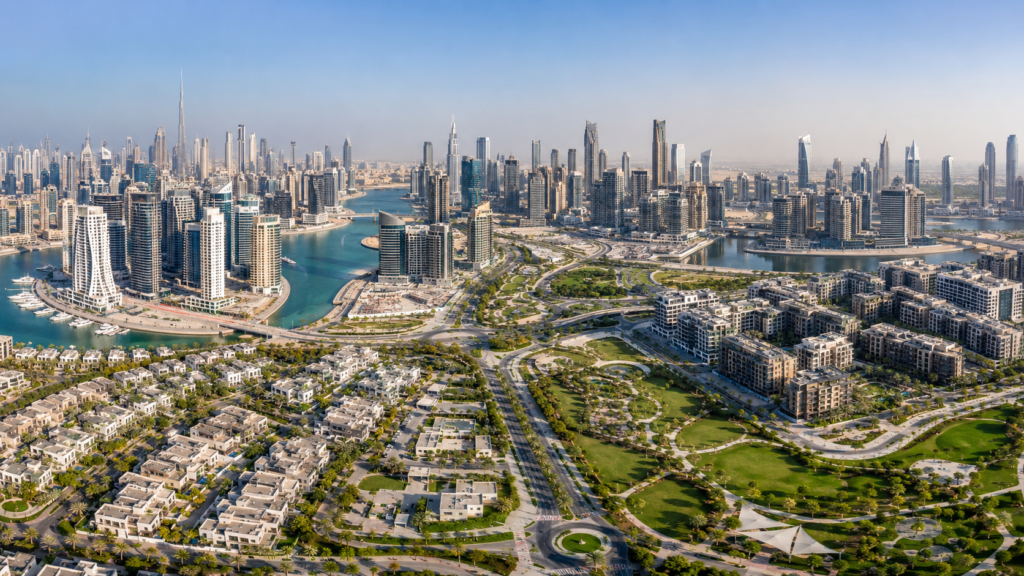
These are the communities I direct Australian buyers toward most consistently. Each one delivers on yield, holds value through cycles, and moves well when you are ready to exit.
Jumeirah Village Circle (JVC)
JVC recorded 18,782 transactions in 2025, making it the most liquid community in Dubai with more than 1,500 transactions per month on average. That liquidity matters enormously when evaluating rental properties in Dubai. You can enter and exit within days to weeks.
JVC offers average yields of 7.21% for three bedroom apartments, according to Global Property Guide data for 2026. Entry prices for one-bedroom apartments start from around AUD 280,000 to AUD 320,000. The tenant profile is young professionals and families priced out of Marina and Downtown. Vacancy rates here are consistently low.
For Australian investors buying their first Dubai investment property, JVC is almost always my first recommendation.
Dubai Marina
Dubai Marina delivers 6% to 8% gross yields with exceptional resale liquidity. The waterfront location, restaurant strip, and lifestyle appeal create a permanent buyer pool. When you are ready to sell, there is always demand.
One bedroom apartments start from around AUD 400,000 to AUD 450,000. Short-term rental setups perform particularly well here given strong tourism and business visitor demand. Fully furnished units can earn 10% to 25% more in annual rent compared to unfurnished stock, according to Engel and Völkers research.
Business Bay
Business Bay sits right next to Downtown Dubai and is moving from mid-market toward premium positioning. Corporate tenant demand is growing as more regional headquarters are established here.
Gross yields sit between 6% and 7.5%. Entry prices for one bedroom units start from AUD 350,000 to AUD 420,000. The capital appreciation story here is arguably stronger than JVC or Marina over the next three to five years. According to Engel and Völkers, Business Bay was among the top communities for apartment lease activity in Q3 2025, reflecting consistent demand for rental properties in Dubai’s central districts.
Dubai Hills Estate
For investors who want family tenant stability and long-term value retention, Dubai Hills is where I start the conversation.
Emaar built this community for families. Parks, a golf course, and direct school access are built into the master plan. Gross yields sit between 5.5% and 7%. Entry prices are higher than JVC, but occupancy consistency and tenant quality justify the premium for investors focused on steady income rather than maximum yield.
Dubai South
This is the highest upside play among all current Dubai investment properties. Dubai South surrounds Al Maktoum International Airport, which is on track to become the world’s largest airport by capacity. That infrastructure catalyst drives long-term demand in a way no other community can replicate right now.
Gross yields are running between 8% and 10% on some stocks. Dubai South was among the top communities for transaction volume in Q1 2026, according to fäm Properties data. Entry prices for studios and one-bedrooms start from AUD 200,000 to AUD 260,000, with developer payment plans available. This suits investors with a three to five year horizon.
Off-Plan vs Ready Property: What Works Better for Australian Investors
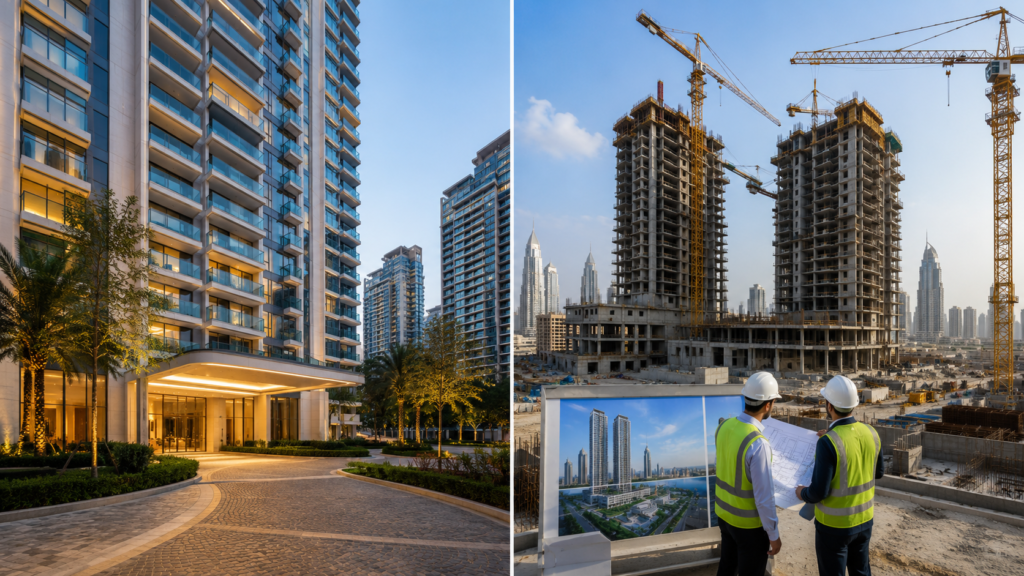
This question comes up in almost every conversation I have with Australian clients. The right answer depends on what you are trying to achieve.
Ready Properties: The Income First Choice
Ready properties generate rental income from the settlement day. No waiting period. No construction risk. The yield on ready Dubai investment property is immediate and calculable.
Ready properties are also easier to finance. Non-resident mortgage products from Emirates NBD, HSBC UAE, and Mashreq are structured around ready stock. Most UAE banks will not extend non-resident financing on off-plan properties.
The trade-off is that you pay today’s market price with less room for the capital appreciation that comes from buying early in a development cycle.
Off-Plan Properties: The Capital Efficiency Play
Off-plan purchases let you buy at launch pricing, which historically sits below the eventual resale value at completion. Dubai developers are increasingly offering flexible 60/40 or 1% monthly payment plans, with off-plan apartment prices averaging AED 2,109 per sq ft in early 2026.
In AUD terms, you can secure a AUD 350,000 Dubai investment property with an initial outlay of AUD 35,000 to AUD 70,000, then stage remaining payments over the construction period. That capital efficiency is one of the main reasons Australian investors are drawn to off-plan.
The off-plan segment accounted for 73% of Dubai sales in Q1 2026, growing 10.3% year on year, according to fäm Properties.
The risks are real though. Stick only to developers with verified delivery records. Emaar, DAMAC, Binghatti, Imtiaz, Ellington, and Omniyat all have completed projects you can check in the DLD registry. If a developer cannot show you finished buildings, walk away.
For off-plan purchases, your payments go into a RERA-regulated escrow account. The developer cannot access those funds until independently verified construction milestones are reached.
SMSF Investors: Can You Hold Dubai Property Inside Your Super?
Yes. And for the right investor profile, it is worth a serious look.
Australian citizens can purchase Dubai investment properties through a Self-Managed Super Fund. The investment must satisfy the sole purpose test, and your SMSF’s investment strategy must explicitly permit overseas property holdings.
Here is why the numbers work inside an SMSF. In the accumulation phase, income is taxed at 15%. Dubai charges zero rental tax. The combination of strong gross yields and that concessional Australian tax rate creates a net return that domestic property inside super rarely matches.
One bedroom apartments in JVC or Dubai South at AUD 250,000 to AUD 300,000 are a natural fit at this price point. The yield is strong enough to cover management costs and still deliver meaningful income to the fund.
Before committing, sit down with your SMSF trustee and a financial advisor who understands international property. The structure needs to be correct before the investment goes in.
The 2026 Market Window: Why the Timing Matters Right Now
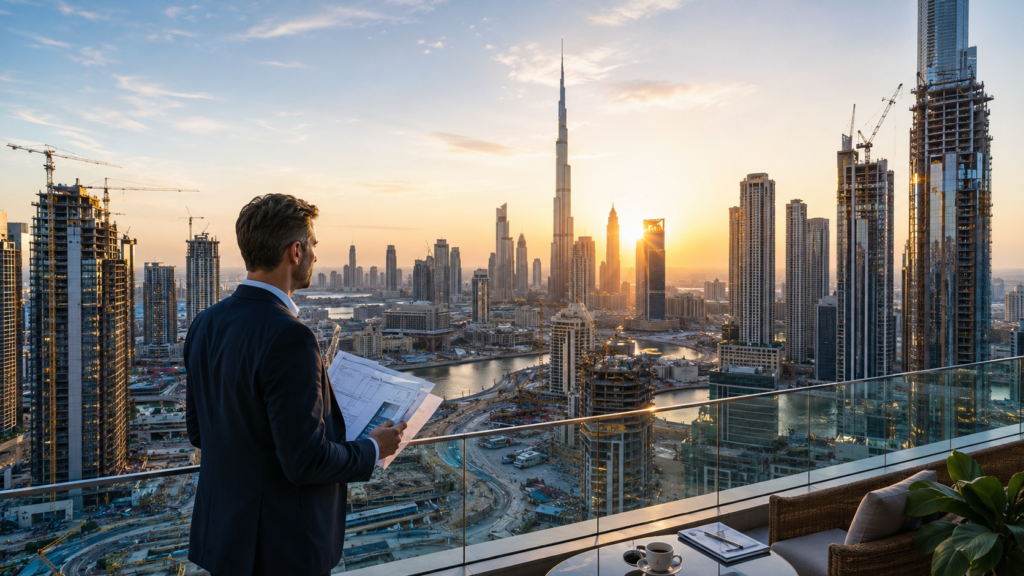
Most articles covering Dubai investment properties were written before the regional conflict. This one was not. That context matters for Australians evaluating the market right now.
Dubai property prices softened 4% to 7% from their pre-conflict peak. Motivated sellers in the secondary market are accepting terms that simply would not exist in a rising environment. Our analysis of the Dubai property market post-ceasefire covers the full picture, but here is the headline.
Dubai recorded AED 176.7 billion in property sales across nearly 48,000 transactions in Q1 2026, with transaction values rising 23.4% year on year, according to fäm Properties. The ceasefire took effect on April 8, 2026. The fundamentals never actually broke.
UAE GDP growth is projected at 5.0% for 2026, supported by a diversified economy across tourism, logistics, and technology, according to Edifice Invest, citing IMF projections.
The AUD is sitting near 0.69 to 0.70 against the USD since the ceasefire announcement, close to a three week high. Temporarily softer prices. Stronger Australian dollar. That combination does not stay available in a market with Dubai’s demand profile.
Full Cost Breakdown for Australian Investors
The listing price is only the starting point. Here is every number you need before committing to any Dubai investment property.
Upfront Acquisition Costs
Budget 7% to 10% on top of the purchase price for total closing costs in 2026, based on Property Finder and DLD data.
- DLD transfer fee: 4% of the purchase price. Buyers typically carry the full 4% unless negotiated otherwise.
- Agent commission: 2% plus 5% VAT on resale properties. Off-plan developers usually absorb this cost.
- Trustee office fee: AED 4,200 for properties above AED 500,000.
- Title deed issuance: AED 580 for apartments.
- Developer NOC fee: AED 500 to AED 5,000, depending on the developer.
On a AED 1.5 million property, around AUD 625,000, the DLD fee alone is AED 60,000. Transaction fees cannot be added to your mortgage. They must be paid in cash upon transfer.
Ongoing Ownership Costs
Annual service charges cover communal maintenance, security, and landscaping. These range from AED 10 to AED 30 per square foot annually. On a 70 sqm apartment, expect AED 7,000 to AED 21,000 per year.
No annual property tax. No capital gains tax on sale. No UAE rental income tax.
Your ATO Obligations
Dubai’s zero tax environment does not remove your Australian reporting duties.
- Rental income belongs on your Australian tax return each year
- Foreign assets above AUD 50,000 must be declared to the ATO
- Management fees, maintenance, and depreciation may be claimable as deductions
- Profits on sale are treated as foreign capital gains in Australia
- Hold for more than 12 months, and the 50% CGT discount may apply for individual taxpayers
Get proper tax advice before your first rental payment arrives.
The Yield Gap Is Real. The Entry Window Is Now.
Dubai investment properties are not a new idea for experienced Australian investors. What is new in April 2026 is the combination of factors making the entry case unusually strong.
Softer prices from the conflict period. A stronger Australian dollar. Developer payment plans are more flexible than they were at the start of the year. And a market that just recorded one of its strongest quarters on record despite regional uncertainty.
The Dubai Property Expo brings licensed developers, legal advisors, and investment consultants to Australian cities throughout 2026. Every exhibitor is Dubai Land Department registered and vetted by Bright Realty International. Come with your numbers. Leave with a plan.
Find your nearest event at dubaipropertyexpoaustralia.com.au.
Frequently Asked Questions
Here are some of the most frequently asked questions that actually hit when we thought about Dubai Investment Properties.
What makes Dubai investment properties more attractive than Australian property in 2026?
The yield gap is the starting point. Australian gross rental yields nationally averaged 3.57% in March 2026, according to Cotality. Dubai averages over 7% on new rental contracts. Add zero UAE property tax, no land tax, and no CGT at sale, and the net return comparison is not close for most investor profiles.
Which Dubai community offers the best rental yield right now?
In 2026, areas like Dubai South, JVC, Arjan, and Dubai Sports City consistently show the highest gross yields among established communities, according to Dubai Invest research. Dubai South is currently pushing 8% to 10% on some stock due to the Al Maktoum Airport infrastructure story. JVC is the most liquid high-yield option.
Can I buy Dubai investment property through my SMSF?
Yes, provided the investment satisfies the sole purpose test and your fund’s strategy explicitly permits overseas property. The combination of strong gross yields and zero UAE rental tax creates a compelling after tax return inside a compliant accumulation phase SMSF. Always get professional advice first.
Do I need to visit Dubai to buy an investment property?
No. The entire transaction can be completed remotely using a Power of Attorney for any paperwork requiring a Dubai based signature. Many Australian investors I work with have never set foot in Dubai before completing their first purchase.
How do I identify trustworthy developers for off-plan investment?
Cross check any developer against the DLD registry for completed projects. The Dubai Property Expo events in Australian cities are the most efficient way to compare multiple vetted developers face to face. Every exhibitor is DLD registered and vetted by Bright Realty International.