Quick Answer:
Buying property in Dubai offers 7 to 12% rental yields, zero income tax, UAE Golden Visa eligibility, and government-regulated buyer protections. For most Australian investors in the AUD 150,000 to AUD 800,000 range, the pros significantly outweigh the cons when the right precinct and asset type are selected.
The Dubai Land Department confirmed AED 252 billion in real estate transactions in Q1 2026 alone. That is a 31% year-on-year increase. Foreign investors contributed AED 148.35 billion of that total, up 26% on the same period in 2025.
But headline numbers do not tell the whole story. Some precincts are generating 8% yields with waiting lists of tenants. Others carry vacancy problems and service charges quietly eroding returns. Understanding the full picture of buying property in Dubai, pros and cons, before you commit, is not optional. It is the difference between a strong performing asset and an expensive mistake.
This guide gives you the unfiltered assessment. Every advantage. Every risk. And an honest framework for deciding whether Dubai investment property is right for your situation in 2026.
Assess Before Buying Property in Dubai
Before weighing up the pros and cons of buying property in Dubai, understand the five criteria that determine whether any specific investment will perform for you.
- Rental yield: consistent monthly income from a high tenant demand precinct
- Capital growth: long-term appreciation driven by infrastructure and supply scarcity
- Freehold access: full ownership rights in a government-designated zone, confirmed on the Dubai Land Department register
- Liquidity: how quickly you can exit when circumstances change
- Service charges: the silent yield-killer most buyers check too late
Every buying property in Dubai pros and cons assessment must be applied at the asset level, not just the market level. A Business Bay apartment and a DAMAC Hills 2 villa exist in the same city. Their risk and return profiles are completely different.
Pros of Buying Property in Dubai

The advantages of buying property in Dubai for Australian investors are structural, not speculative. They are built into the legal and tax framework of the UAE itself.
High Rental Yields
Average rental yields on Dubai apartments reached 7.25% in 2025, with high-demand zones delivering up to 8%, according to GuestReady market data. In Jumeirah Village Circle and Business Bay, yields regularly push toward 10%, confirmed by Dubai Land Department transaction records.
Compare this directly to Australia. Sydney gross yields average 2.8 to 3.5%, according to CoreLogic. Melbourne sits between 3.2 and 3.8%. After land tax, management fees, and income tax at up to 45%, net returns on Australian investment properties are critically thin for most investors in higher tax brackets.
Zero Tax on Rental Income
One of the strongest pros when assessing buying property in Dubai, pros and cons, is the UAE’s zero tax environment. There is no income tax on rental earnings, no capital gains tax on resale, no stamp duty on purchase, and no land tax for foreign owners.
The ATO still requires Australian residents to declare Dubai rental income and pay Australian income tax at their marginal rate. However, the removal of a UAE tax layer means significantly more gross income reaches you before Australian obligations apply. For investors in the 37 to 45% tax bracket, this structural advantage improves net yield considerably compared to any locally held rental property.
UAE Golden Visa Eligibility
Buying property in Dubai at AED 2 million or above unlocks 10-year UAE residency through the Golden Visa program. At current exchange rates, that equals approximately AUD 800,000.
Golden Visa holders gain the right to live, work, and travel freely in and out of the UAE. They can open UAE bank accounts, sponsor immediate family members, and access the country’s healthcare and education systems. Many buyers specifically structure their budget around the AED 2 million threshold because the residency benefit carries real value well beyond the property return itself.
For the full eligibility framework, read our guide on buying property in Dubai for the Golden Visa.
Interest-Free Payment Plans
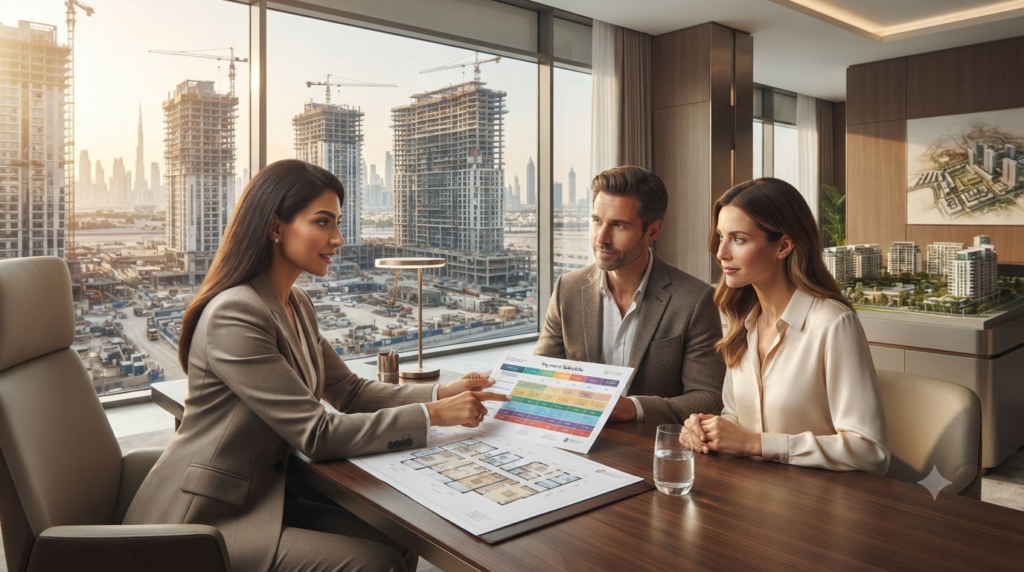
Off-plan buying property in Dubai gives Australian investors access to structured interest-free payment plans that local property markets simply do not offer. Typical structures include:
- 60% during construction, 40% on handover
- 70% during construction, 30% on handover
- Post-handover plans extending up to three years beyond project completion
- Entry deposits as low as 10% of the total purchase price
These structures allow Australian investors to participate in the Dubai market without committing full capital upfront. For investors with existing equity in local property, a payment plan approach can deliver Dubai exposure without requiring a full property sale back home.
Government-Regulated Protections
The UAE’s regulatory framework for property buyers is one of the strongest in the region. RERA requires all off-plan developers to hold buyer funds in government-audited escrow accounts, only releasing payments at verified construction milestones. Title deeds are permanently registered with the Dubai Land Department and backed by the UAE federal property law.
For Australian investors, this means your ownership is not dependent on a developer’s continued solvency. It is a government-registered title, comparable to how property title works in Australia. Our full guide on Dubai freehold properties for foreigners covers the full ownership and legal protection framework.
Is Buying Property in Dubai Right for Your Budget?
The AED 2 million threshold changes the buying property in Dubai pros and cons equation significantly. Cross it, and Golden Visa eligibility is unlocked.
| Budget (AUD) | Best Precinct | Asset Type | Primary Return |
| Under AUD 200,000 | JVC, Dubai South | Studio or 1-bed apartment | Rental yield 7 to 9% |
| AUD 200,000 to AUD 500,000 | Business Bay, Dubai Marina | 1 to 2-bed apartment | Yield and capital growth |
| AUD 500,000 to AUD 800,000 | Dubai Hills Estate, Dubai Creek Harbour | 1 to 2-bed or townhouse | Growth and Golden Visa approach |
| AUD 800,000 and above | Downtown Dubai, Palm Jumeirah | Premium apartment or villa | Prestige, long-term capital, Golden Visa |
Budget guidance drawn from Dubai Land Department Q1 2026 transaction data and Property Monitor benchmarks. For a full step-by-step buying process, read our guide on how to buy property in Dubai from Australia.
Cons of Buying Property in Dubai

An honest assessment of the pros and cons of buying property in Dubai must cover the real risks. These are not reasons to avoid the market. They are factors to manage actively.
Market Volatility in Segments
Dubai’s property market can experience sharp movements, particularly in the luxury segment. Palm Jumeirah and Downtown Dubai assets are more exposed to global wealth cycles and geopolitical sentiment than mid-market investment precincts.
Investors in the AED 800,000 to AED 2 million range are better insulated. High tenant demand in JVC, Business Bay, and DAMAC Hills 2 provides a structural cushion against price volatility. Always check transaction volume before committing. According to DXB Analytics, JVC recorded 18,782 transactions in 2025, over 1,500 deals monthly. A well-priced JVC unit finds a buyer within days. An emerging area with 400 annual transactions can take months to exit.
Currency Exchange Risk
The UAE Dirham is pegged to the US Dollar at a fixed rate since 1997. This eliminates internal UAE currency volatility. However, Australian buyers transact in AUD, meaning the AUD to USD exchange rate determines the effective entry cost and future repatriation value of rental income.
A falling AUD increases the effective cost of a Dubai property purchase and reduces the AUD value of rental income repatriated to Australia. This risk is manageable through currency hedging strategies and timing your conversion with a specialist currency broker. It is a factor to plan for, not a reason to avoid the market.
Service Charges of Buildings
Service charges are the most commonly overlooked factor when assessing the pros and cons of buying property in Dubai. In JVC, service charges vary between AED 5 and AED 20 per square foot annually. A AED 5 per square foot difference can shift your net yield by a full percentage point.
Always request the RERA-registered service charge figure for any specific building before signing. Never rely on developer estimates. The Dubai Land Department’s RERA service charge index publishes official figures for every registered building.
ATO Reporting Obligations
Buying property in Dubai does not remove Australian tax obligations. All Australian residents must declare Dubai rental income to the ATO and pay Australian income tax at their applicable marginal rate. This is a compliance obligation, not a dealbreaker, but it requires active management.
Engaging a tax accountant experienced in overseas property investment from the outset eliminates compliance risk. Legitimate deductions, including management fees, depreciation, and maintenance costs, can reduce the net Australian taxable amount considerably.
Overseas Management Complexity
Managing rental properties in Dubai from Australia requires a trusted local property management company. Without local representation, vacancy periods extend, maintenance issues go unresolved, and rental income is inconsistently collected.
Quality Dubai property management companies charge 5 to 10% of annual rental income. This cost is deductible, comparable to Australian management rates, and essential for any Australian owner not based in the UAE.
Property in Dubai Pros and Cons: At a Glance
| Factor | Pro | Con |
| Rental yield | 7 to 12% gross in key zones | Varies by building and service charge |
| Tax | Zero UAE income and capital gains tax | Australian income tax still applies |
| Ownership | Permanent freehold title via DLD | Restricted to designated freehold zones |
| Payment | Interest-free developer payment plans | 4% DLD transfer fee on purchase |
| Residency | Golden Visa at AED 2 million | Currency exchange risk for AUD buyers |
| Management | Professional local management available | Requires a trusted overseas manager |
| Liquidity | High in JVC and Business Bay | Lower in the emerging and luxury segments |
Pros at the Dubai Property Expo Australia

Understanding the pros and cons of buying property in Dubai is the foundation. Seeing the actual projects, comparing live pricing, and speaking directly with licensed developers and Australian tax specialists is the next step.
The Dubai Property Expo Australia brings over 100 verified, RERA-licensed projects directly to Sydney, Melbourne, Brisbane, and Perth. Every developer on the expo floor is vetted by Bright Realty International before the event opens. No pressure. No generic listings. Just the right project, the right precinct, and the right entry point for your goals.
Register your free place today at dubaipropertyexpoaustralia.com.au.
Frequently Asked Questions
Is buying property in Dubai a good investment for Australians in 2026?
Yes, for investors targeting yield and long-term growth in mid-market precincts. Buying property in Dubai has several pros, including 7 to 12% gross yields, zero UAE tax, and government-regulated buyer protections. The main cons for Australians are ATO reporting obligations and currency exchange risk, both of which are actively manageable.
What are the main pros of buying property in Dubai?
The core pros are high rental yields of 7 to 12%, zero UAE income and capital gains tax, interest-free developer payment plans, government-regulated escrow protection, permanent freehold title, and UAE Golden Visa eligibility at the AED 2 million threshold.
What are the main cons of buying property in Dubai?
The key cons include market volatility in luxury segments, AUD to USD currency exposure, service charge variation between buildings, ATO income reporting obligations for Australian residents, and the need for a trusted local property manager.
How does buying property in Dubai compare to buying in Australia?
Dubai delivers gross yields of 7 to 12% against Australia’s 2.8 to 4.2%. There is no UAE income tax versus Australian marginal rates of up to 45% on rental income. Entry prices start from AUD 150,000 in Dubai, compared to AUD 500,000 plus for investment-grade apartments in any major Australian capital.
Can Australians own freehold property in Dubai?
Yes. Australians have held full freehold ownership rights in designated Dubai zones since 2002. No UAE residency or local sponsor is required. Ownership is permanently registered with the Dubai Land Department. Read our full guide on how Australians can buy property in Dubai for the complete legal framework.
What is the biggest risk of buying property in Dubai?
The biggest risk is buying in the wrong precinct or building. A poor location, high service charges, and low transaction liquidity can erode returns significantly. Always verify RERA service charge figures, check annual transaction volumes, and work with a verified RERA-licensed developer. The Dubai Property Expo Australia vets every project before it reaches the expo floor.
Do I pay Australian tax on Dubai rental income?
Yes. Australian residents must declare all worldwide income, including Dubai rental earnings, to the ATO. However, no UAE tax applies, meaning more gross income is retained before Australian obligations apply. Legitimate expenses are deductible and may reduce your net taxable amount considerably.